

Research and Resources
"When you do not teach the child to be independent, you teach the child to be dependent."
— Dr. Maria Hari, Peto Institute
CFI CASE STUDY
— Savanna Yu, PT, DPT
introduction
This case study examines a pediatric patient with impaired bilateral contralateral coordination, motor planning deficits, reduced strength, and decreased postural balance, using exercise-based goals and 1-minute sit-to-stand test data to analyze progress following a 10-week therapy program targeting strength, coordination, postural control, and gait.
DEMOGRAPHIC
16 year old male diagnosed with spastic quadriplegic cerebral palsy GMFCS level-2.
MANAGEMENT
Participated in intensive therapy sessions focusing on strength, anticipatory and reactive postural balance, coordination, and gait with an emphasis on peer driven motivation environment. Each session individualized to the patient to improve motor planning and neuroplasticity for each exercise.
Duration: 2 hours, 1x/ week for 10 weeks.
RESULTS
Patient has demonstrated significant improvements in contralateral limb coordination, including the following:
- Consecutive skipping oImprovement: Demonstrates correct alternating limb placement with increased ability to perform multiple consecutive repetitions.
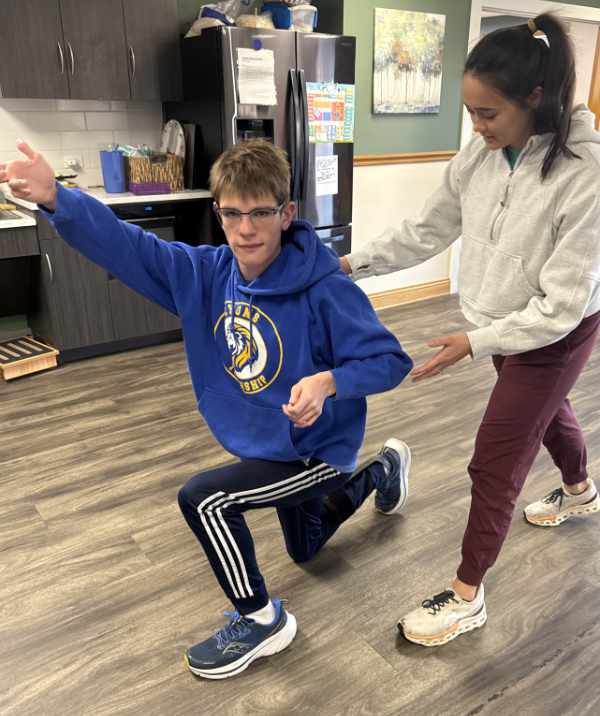
- Alternating lunges oImprovement: Improved motor planning, evidenced by decreased delay in stepping rhythm and the ability to alternate lunge steps immediately rather than requiring multiple steps between repetitions.
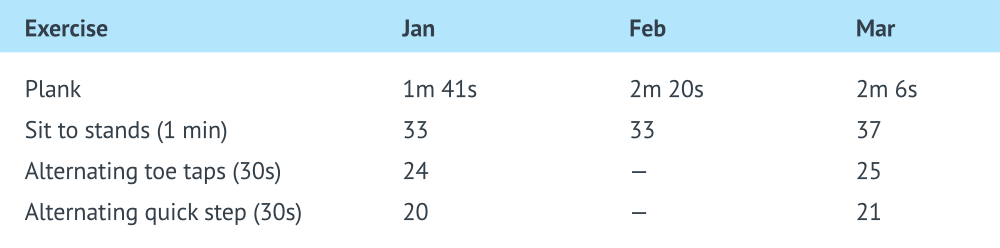
Significant improvements in overall strength, endurance, and functional mobility-based progress in specific exercises including:
DISCUSSION
This case demonstrates that targeted interventions in a peer driven environment addressing strength, postural balance, and coordination can improve bilateral contralateral coordination, motor planning, neuroplasticity. Following 10 weeks of weekly therapy focused on strengthening, anticipatory and reactive balance, and task-specific coordination, the patient demonstrated improved reciprocal arm swing with lower extremity coordination during functional activities. Notable improvements were observed in consecutive skipping, with correct alternating limb placement and increased repetitions, and in alternating lunges, with improved motor planning and reduced delay in stepping rhythm. The patient also demonstrated gains in overall strength, endurance, and functional mobility as evidenced by progress in exercises such as planks, sit-to-stands, and alternating toe taps. These findings suggest that combining foundational strength and balance training with task-specific coordination activities can support improved motor control and efficiency during dynamic movements.
CFI CASE STUDY
— Brooke Zausa,OTS
purpose
The purpose of this case study was to highlight progress since the patient started intensive motor therapy with peer driven learning model with neurological and physical disabilities.
INTERVENTION
An 1-year 9-month old child with unspecified lack of expected normal physiological development in childhood, participated in intensive motor therapy using a peer driven learning model through Conductive Education. She received 2.5 hours of therapy twice a week for 2 months. Her individualized plan of care includes occupational therapy focusing on play, ADLs, and feeding. Her plan of care for physical therapy consists of crawling, ambulation, and overall strengthening. This interdisciplinary approach addresses the child's developmental needs through skilled therapeutic interventions embedded in a socially interactive setting.
PDMS-3
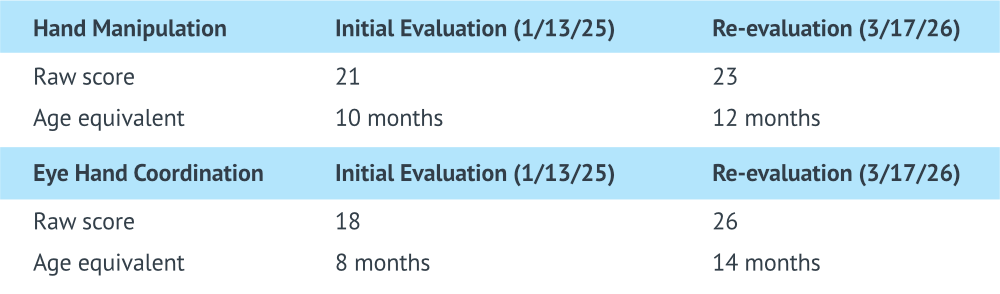
The PDMS-3 measures a young child's gross and fine motor development, including skills like movement, coordination, balance, and hand use. Hand manipulation measures the ability to move the hands and fingers to complete tasks and measures dexterity. For example, this includes manipulation of objects such as blocks and cups. Eye hand coordination measures the ability to interpret visual stimulation in coordination with hand finger movements. Occupational therapy measures hand manipulation and eye hand coordination subtests to assess the ability to use hands and fingers in functional tasks such as eating, dressing and play.
Overall the patient has made significant progress in fine and gross motor skills as well as emotional regulation and social participation when completing an intensive therapy peer driven motor therapy program. The patient's improvements in self feeding reflects the progress in both hand manipulation and eye hand coordination skills. Her improvements in fine motor development as measured by the PDMS-3, support increased independence in functional activities of her daily life.
FINDINGS
The patient demonstrated significant progress towards independence in feeding, dressing, motor planning, ambulation, balance, and strength. This is further supported by the achievements of occupational therapy and physical therapy goals she has completed throughout the course of treatment. Significant improvement was demonstrated in feeding, as the patient previously had no functional use of utensils requiring max assistance and now requires minimal assistance for spoon and fork use, reflecting increased independence in ADLs. She demonstrated good motor planning skills bringing utensil to mouth when loaded with food. She has a strong pronated grasp on utensils showing good hand strength and stability. The peer driven model has positively impacted this progress by observing peers' use of utensils and participating in mealtime providing modeling and opportunities for social learning.
At the start of therapy the patient would be dys regulated during therapy sessions by crying and not actively participating. She has demonstrated progress in social participation and emotional regulation with ability to remain engaged throughout sessions. She has become increasingly social with peers interacting, observing, and participating in activities alongside them which has supported her overall progress and engagement in therapy sessions.
American Academy for Cerebral Palsy and Developmental Medicine
2023 Community Forum - Disability Employment
Patti Herbst, CPA is the founder and Executive Director of Center for Independence through Conductive Education, an Illinois nonprofit. The mission of the Center for Independence is to help children and young adults with disabilities achieve their highest level of independence in the home, school, community and workplace. Patti is the mother of an adult with cerebral palsy and brings her unique understanding of the barriers people with disabilities face in transition to adulthood, especially in accessing the workforce.
Research Study on Conductive Education
With a grant from the Coleman Foundation, the Center for Independence and Governors State University are conducting a 2 year Research project on the impact of CE on a child's performance of functional skills.
Quantitative research in Conductive Education in the US is woefully lacking. Two years ago we undertook a research project that would attempt to objectively measure change in the performance of functional skills for children attending a Trans-disciplinary Conductive Education (TCE) program near Chicago. In collaborating with the research scientists and the therapists and conductors it was determined to measure change in 3 functional activities: hand to mouth, sit to stand, and ambulating. Children were identified to be part of the research study by recommendation of their treatment team (conductors and therapists). Each child’s parent gave consent for their child to participate. The research study protocol called for monthly data collection session to be closely timed with the alternating month on/month off attendance schedule for the school age children.
Case Study on CE participant over an 18 month demonstrates clinically significant functional improvements.
Recommended Websites
- ACENA (Association for Conductive Education in North America)
- Aquinas College POHI Program (physically and/or health impaired)
- Cerebral Palsy Group provides educational information and support
- Cerebral Palsy Guide Helping Children with Cerebral Palsy
- Cerebral Palsy Guidance Provides CP answers and assistance to parents
- Cerebral Palsy Research Network Promoting lifelong health and wellness for people with CP, and their families, through high quality research, education and community programming
- Governors State University Conductive Education OT Certificate
- Mayo Clinic Reference page about premature birth complications
- NICE (National Institute if Conductive Education, UK)
- SBAIL The Spina Bifida Association of Illinois
- Tsad Kadima The Association for Conductive Education in Israel
- CPRR (Cerebral Palsy Research Registry) —improving the understanding of cerebral palsy
Recommended Reading
- Conductive Education: A Functional Skills Program for Children with Cerebral Palsy
Helen Bourke–Taylor, Roberta O’Shea, Deborah Gaebler–Spira - Conductive Education: History, Definition and Basic Concepts
Rony Schenker OT, PhD Professional Director, Head of Conductive Education and Cerebral Palsy Studies – Tsad Kadima (A step forward)
Other Resources
- Connecting CP Families on Facebook
Started by Meade Whitaker where parents, with children diagnosed with Cerebral Palsy (CP), can ask questions and receive advice from other parents that are in a similar situation. - Disability Benefits 101
Many people with disabilities fear that if they go to work, they'll lose needed health care and other disability benefits. Disability Benefits 101 (DB101) helps people with disabilities and service providers understand the connections between work and benefits. DB101 will help you make informed choices and show you how you can make work part of your plan. - DRS & DDD Comparison of Eligibility and Services
This chart (PDF) offers a comparison of the differences between the DRS and Adults with DD Medicaid waivers that must be considered when making this choice. - Understanding PUNS: A Guide (PDF) to Prioritization for Urgency of Need for Services.
- PUNS: Finding your way info map (PDF)
- Understanding Disability Benefits (PDF)
Our Mission
Our mission is to help children and young adults with disabilities achieve their highest level of independence in the home, school, community and workplace. We offer affordable therapy programs that help children with physical disabilities develop self-determination and an “I Can!” attitude. The Center breaks down employment barriers for adults with disabilities through our innovative program, Working Together Chicago.
The Center is an IL 501(c)3 non-profit organization. EIN: 36-4259162
Our Vision: That children and young adults with disabilities have the opportunity to be fully participating members of the community.
Intensive Motor Therapy - Reach Your Potential!
Center Hours
Monday - Friday: 8:30 AM - 6:30 PM
Program times vary — check calendar.
2025-2026 Program Calendar
Quick Contact
Center Locations
CFI Main Center
100 W. Plainfield Rd.
Countryside, IL 60525
Brighton Park
2701 W. 36th Pl.
Chicago IL 60632